Tuesday, September 15, 2020

Nagmanflow's Flow Meters and the complete study

         flow meters is a device used to calculate the linear, the nonlinear, mass and volumetric flow rate of a fluid or a gas. When selecting the flow meters, one ought to think about such subtle factors as expertise of plant personnel, their knowledge with calibration and maintenance, spare parts accessibility, and meantime linking failure history, etc., at the particular plant site. It is also suggested that the cost of the installation be calculated only after taking these steps.


     One of the most general flow measurement mistakes is the reverse of this sequence: instead of picking a sensor which will execute correctly, an effort is made to justify the use of a device since it is less expensive. Those "inexpensive" purchases can be the most expensive installations. This blog will help you comprehend flow meters, and you can also converse to our application engineers at any time if you have any particular flow measurement challenges.


        The primary step in flow sensor variety is to resolve if the flow rate information should be constant or totalized and should consider if this information is required locally or remotely. If a little, how should the transmission be? Should the transmission be analogue, digital, or shared? And, if shared, what should be the minimum data-update frequency. And if an answer is derived from the question, an assessment of the properties and flow uniqueness of the process liquid, and of the piping that will house the flow meter, must take place. To come up to this task in a methodical manner, forms have been developed, so that the following types of data are entered for each application.


    The fluid and its specified pressure, temperature, permissible pressure drop, density, conductivity, viscosity and vapour pressure at highest operating temperature are listed, jointly with a suggestion of how these properties might vary or interact. In toting up, all security or toxicity levels should be provided, collectively with exhaustive data on the fluid's composition, presence of bubbles, solids, tendency to coat, and light transmission qualities.


    Probable minimum and maximum pressure and temperature values must be given in adding to the usual operating values whilst choosing flow meters. Can the flow reverse, will it always fill the pipe, does the slug flow can develop air-solids-liquid, if aeration or pulsation is probable, can the sudden temperature changes can happen, or only particular precautions are required throughout cleaning and maintenance, these particulars, too, should be confirmed.


       Regarding the piping and the region where the flow meters are to be located, consider: For the piping, its course must avoid downhill flow in liquid applications, size, material, and schedule. The engineer ought to identify if vibration or magnetic fields are present or likely in the area if electric or pneumatic power exists, if the spot is classified for explosion hazards, or if there are previous exceptional requirements such as observance with sanitary or clean-in-place (CIP) regulations.

Tuesday, September 8, 2020

Nagman's New Strike

     Nagman’s Mobile Flow Calibration System presents itself to be extremely reliable and strong. The Mobile Flow Calibration contains accuracies better than 0.3% and methods in comparison. The meter sizes of Mobile Flow Calibration System start from DN6 extending to DN 100.


Mobile Flow Calibration System


      The Instruments Consortium Company impresses with flow rates from 1 to 2000 LPM with reservoir volume up to 3000 liters. The Mobile Flow Calibration System speaks of lines 1, 2 or 3 to suit with a calibration campaign time from 30 seconds. The system is best suited for Calibrating Electro-Magnetic Flow Meters/ Mass/ Vortex/ Ultrasonic and PD type Flow meters.

     Nagman’s Mobile Flow Calibration allows water as its calibration media and the units which could be tested under it can be single or multiple (whichever suits better). This system operates under three different methods – Manual, Semi and Fully Automatic. Plenty of information regarding the Mobile Flow Calibration System can be found at NagmanFlow’s website.


Friday, August 14, 2020

PROCESS FLOW METER CALIBRATION SYSTEM

 The Flocal Series by Nagman Instruments Consortium, a PAN India Company, sizes in meters from DN10 up to DN 400 with many more sizes presented to you. It provides a good flow rate between 1 to 25000 LPM or more depending on your requirement.

In order to make sure it suits, the ProcessFlow Meter Calibration System comes with 1, 2 or 3 lines, providing a Calibration Campaign Time from 30 seconds.

The Process Flow meter Calibration System comes with different Calibration Methods such as Gravimetric or Volumetric or Comparison with accuracies ranging from 0.2% to 0.05%.

Water, the correction factor for other liquids serves as the Calibration Media. The number of units to test depends on what suit the best – Single or Multiple.

The display or control console as some call it directs the Flow Rate, Total Flow, Start/Stop Timer and a lot more all operated Manually; Semi or Fully Automatically. Any of the operations methods could be used depending on the convenience.

The automation functions as PLC; HMI or SCADA. On the other hand, System Modules include Pumps with VFD/ Distribution Headers / Mounting Clamps / Spacers – Reducers, Adapters / Electro-Magnetic Meters (Flow Setting Masters) / Valves / Measuring Tanks / Flow Diverters / Weigh scales, Load Cells / Storage Tanks++.

Each best suited for Calibrating Flow Elements/ Electromagnetic/ Mass/ Vortex/ Ultrasonic/ PD Type Flow Meters.

The company, Nagman Instruments Consortium, was founded in the year 1972 serving the global market ever since. The organisation offers Comprehensive Calibration Solutions to customers through its various branches. The company jostles with a vision to identify niche avenues and potentials across the globe and enhance the business in the Filed Instruments and Calibration Systems.

Wednesday, February 26, 2020

All You Need To Know About Level Transmitter


A Level Transmitter is an instrument that provides a continuous level measurement. It is used to find the number of particular states of matter at a selected time – which suggests that liquid, gas, of semi-solid substances, are measured by a level transmitter.


The principle is the instrument has various types that are used for various uses. The pressure of the matter is a huge concern to pick the right Level Transmitter. It can be measured in three different ways:

  • The weight of the fluid
  • The pressure head of the fluid
  • The position of the fluid in a container

When you speak about level measurement, it is classified into two types: direct measurement and indirect measurement also known as, contact or non-contact transmitters. Direct Measurement of Contact Transmitters is considered for small level changes, which are observed in various industrial tanks. However, it must be noted that the Transmitters are mostly designed for indirect measurement. 
     

The various types of Level transmitters are as follows:

  1. Capacitance Level Transmitters
  2. Hydrostatic Level Transmitters
  3. Magnetic Level Transmitters
  4. Radar Fill Level Transmitters
  5. Ultrasonic Level Transmitter
  6. Guided Microwave Level Transmitters

If individuals are in the requirement of Level transmitters for industrial requirements – Nagman is the destination for the product. Level Transmitter are suitable for the enhancement of your business and industry – make sure you choose the right one.


Thursday, February 20, 2020

An Introduction to Flow Meter


          A flow meter is an apparatus that is used to gauge and evaluate the volume of a gas or liquid substance. They can be acknowledged as flow gauge, flow indicator, liquid meter, and flow rate sensor. Rivers and Streams can be measured using the flow meters. Improving the accuracy, precision, and resolution of flow measurement is the greatest benefit of flow meters.


Flow Meters are used to provide clear-cut monitoring. There are various kinds of flow meters in the market, but one must be clear and understand the kind of flow meter they require and is in sync with their current requirements. 

One must choose the right technology and a few important points must be remembered when you think about purchasing a flow meter. 

  • The type of Gas or Liquid that is being measured 
  • Least amount and maximum flow rates 
  • Based on your requirement – the accuracy requirement. 
  • The temperature and viscosity of the fluid or gas.
  • The compatibility of the materials 
  • The maximum limit of the pressure 
  • The amount of pressure that can be allowed 
  • Is the meter mounted? Where is the meter mounted? Look at the location before mounting. 
  • Is fluid flow continuous? 
  • The type of output you require – the kind of readout you need. 

Choose Nagman’s FlowMeters to get the best and accurate requirement with respect to your needs and technological advancements. One must understand the right flow meter to implement to get the right set of & apt readings with respect to their business and industry. 

Monday, January 6, 2020

Types Of Level Transmitters From Nagmanflow

Level Transmitters

Nagman calibration LLC a unit of Nagman Instruments PVT ltd is the first calibration laboratory in India to be accredited with ISO/IEC 17025 standards and NABL empanelled auditors & quality control Inspectors with ISO9001/14001for total calibration solutions. Nagman calibration labs in Chennai & Mumbai covers all scientific parameters like Thermoelectric, Mechanical (Pressure, vacuum, flow, temperature, level, mass, dimension and volume) & fluid flow (Process flow meter & water calibration meter). The centres are also equipped with sophisticated calibration equipment and computerized automated calibration reporting of primary/secondary transfers of data.  

Flow meter calibration can be divided into four sections, namely LEVEL, liquid, gas & mobile flow calibration meters.
LEVEL calibrations use Electrical / Electronic and Pneumatic Consoles are housed in a sleek Panel / Test Bench Rack, designed ergonomically; a stand-alone Hydro (Water) Intensifier Unit caters to Pressure Tests. With Built-in Intelligent Software (with the facility of Retrieving / Recording / Interpreting & Displaying the Readings / Values received from various Test and Standard Instruments in easily understandable/user-friendly format) is provided for generation of Calibration Certificate / Chart / Report.
Nagmanflow’s Types of Level Calibrators
Nagman’s Radar Level Transmitter – NAGLEV 6G Series
Operates with the antenna system in principle of microwave transmitted signal with a short pulse, high frequency & resolution. The measurement time which is quick makes this a known for accurate measurement in Industrial circle. Even in complex & critical conditions these Radar level transmitters use false echoes with embedded software connected to the sensor, for processing & debugging the level accurately.
Nagman has six types of Radar level transmitting meters, namely QTRD 801 to 806. All these have a measurement precision of ± 10mm, with a temperature range from -40 to 400 degree Celsius. The main aspects that differentiate these radar level transmitters are the scientific proprieties in Industrial scale-like corrosive both light & high, pressure variance, and solid, sticky, viscous, dielectric & mixed liquid/temperature mediums.
Nagman’s all radar level transmitters are intrinsically safe with EXIAICC T6Ga flameproof quality standards and made with stainless steel body/Aluminum shell protection cover.
Nagman’s Radar Level Transmitter – NAGLEV 2G Series
Operates with the same principle of 6G series but has more potential radar sensor with high frequency and embedded with new fast microprocessors to the antenna for accurate readings. Nagman’s 2G series is resilient to all sorts of external turbulences such as pollution, corrosion, temperature/pressure distortions.
Nagman’s 2G Radar level transmitting meter models are HTRD 601 to 906 series, with measuring range up to 70 meters, Accuracy range from:±3 to:±15mm in models, the Temperature range of -40 to -250 degree Celsius & process pressure of 0.1 to 0.4 MPA. 
Both handheld and mounted models are available as per requirements with fixed with LCD display. Installation methods and techniques can be referred through Nagman’s catalogues.
NAGLEV Series GWR
Nagman’s Guided Wave Radar meter operates in the principle of Reflected pulse signal along the cable or rod probe-type transmit to the instrument electronic circuit parts, the microprocessor processes the signal, identify the microwave pulse-echo generated in the material surface. Correct identification of the echo signal have completed the implementation by the pulse software.
Nagman’s guided wave radar meter has five models from gwr 701 to 705, with measuring range from 6 to 30 meters based on models, the precision of ± 10mm, Frequency of 500 MHZ to 1.8GHZ & a wide temperature range of -40 to 400 degree Celsius.
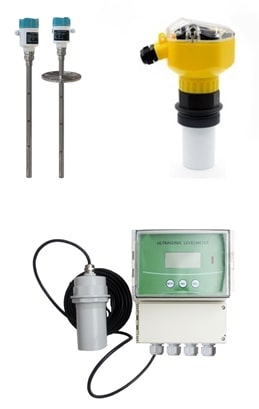
Nagman’s Ultrasonic Level Transmitter – NAGLEV Series US
Operates on the principle of; sensor of the meter pulses in the direction of the product surface. There, they are reflected back and received by the sensor. The meter measures the time t between pulse transmission and reception. The meter uses the time t (and the velocity of sound) to calculate the distance D between the sensor membrane and the product surface. In gas mediums the ultrasonic velocity of the gas is influenced by the gas temperature, so the material level meter compensates sound velocity for the gas temperature at work.
Product Introduction Model Parameters US 4 US 6 US 8 US 10 US 12 US 20 US 30 Application Industrial Level Measurement Measuring Range liquid:0.2-4 m liquid:0.25-6 m liquid:0.3-8 m liquid:0.4-1 0m liquid:0.5-12 m liquid:0.8-20 m liquid:1.2-30 m Process Connection G2 Thread M95X2.0Thread Energy Transducer Material ABS,PVC,PTFE Temperature -40~ 75 Deg C (LCD:-20ºC~ +70ºC) Temperature compensation The whole range with automatic compensation Process Pressure ±0.1MPa Precision 0.2% of actual range Signal output 4-20mA(Option: RS485 / HART/ Alarm) Power Supply DC20V~32 ≥30mA Display Resolution Ratio 1mm Mode of Indication 4 Digit LCD Cable Diameter Ø 6-12mm Single Wire Diameter Ø 0.5-1.78mm Cable Entry/Seal M20/PG13.5 Beam Angle 8º(3db) Measurement Cycle 1.5 seconds.
Features are Integrated design, installed conveniently; Protected in the excessive voltage and current, protected in the thunder and lightning. The big show window of LCD is easy to debug and observe;  Over-voltage over-current protection, lightning protection;  Advanced since the clamp type terminal, to ensure that wiring never loose;  Intellectual signal treatment technology, guarantee that the instrument meets various kinds of operating occasion;  All plastic probe, acid and alkali resistant, adapt to bad environment.

Friday, November 22, 2019

Why is Ultrasonic flow meters becoming a favourite choice in the Industry?

Ultrasonic Flow Meters

 The Ultrasonic flow meters operate on the principle of Ultrasonic sound waves when passed through a flow pipe, determining the velocity of the fluid in it. When there is no flow in the pipe, the frequency of the ultrasonic sound waves gives out the same input frequency. When there is a flow inside the pipe, the frequency of the Ultrasonic flow meters increase in response with the speed of flow in Linear.

Nagman Instruments a pan India Company since 1972, with global supply, is a pioneer in Instrumentation & calibration systems. The company with its five types of flow meters that operates on by principles, has introduced a versatile Ultrasonic flow meter that can be used in various industrial applications. Nagman Ultrasonic flow meter comes with a wall mounted & handheld with three types of sensors S2, L2 & M2 that can be fitted with purpose applications. Virtually supports all sorts of fluid and liquid flow in Industrial applications. Interfaced through RS 232 communication mode; it comes with a 7 digit totals for positive and negative flow. Nagman Ultrasonic flow meter has a temperature range of -10 to 160 deg Celcius, Sound accuracy of  ±1% of Reading at rates > 0.2 mps, velocity of 0 to 10m/s.


Why is Ultrasonic flow meters becoming a favourite choice in the Industry?

Ultrasonic flow metres when compared to other types based on their principles of working, has its own salient features.
-          Ultrasonic flow meters have less connected parts or in other words devoid of internal design complexity.
-          Its working principle just depends on a beam of sound waves passed through the pipe medium which makes it a precise and accurate measuring in flow meters.
-          The frequency variation does not distort or trouble the flow of fluid in pipes, as it just a sound wave passing through or transmitted across the medium.
-          Ultrasonic flow meters are versatile with wall-mounted and handheld options in AC/DC supply.

  Flow meter hire is the same ultrasonic flow meter with hiring (use & return) option. The Instrument, when required for a short period time in measuring flow in pipes in certain critical & remote applications, can make use of the flow meter hire. Not all industrial applications are in the house in piping and flow. Many applications are external in offshore and onshore with pipelines. So Ultrasonic flow meter hire options enhances the safety and reliability of piping systems in those areas, with its accurate and steady working principle.